
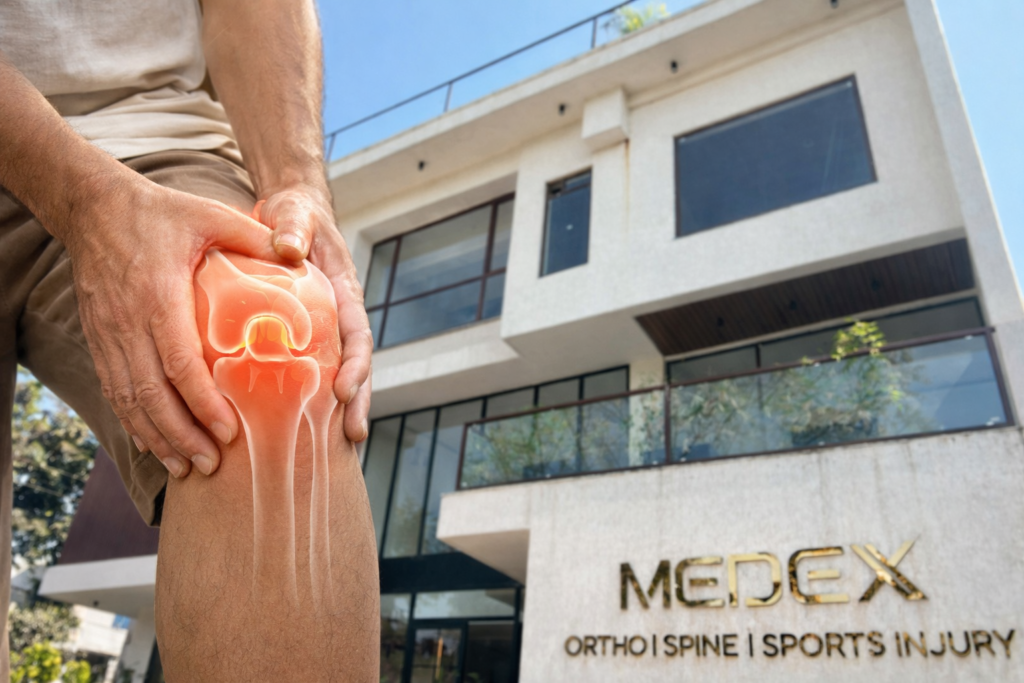
Not every knee pain needs surgery. In fact, most don’t.
If you’re dealing with stiff, aching, or swollen knees and someone has already told you “surgery karwao,” hold on. There are real, clinically backed treatment options that don’t involve going under the knife — and they work for a large number of patients right here in Bhopal.
At Medex Orthocare, Dr. Pragyesh Saxena has been treating knee pain non-surgically for years. Slip disc, osteoarthritis, ligament injuries, sports damage — most of these respond well to the right combination of therapies when caught early enough.
Here are 7 non-surgical methods we use at our clinic in Arera Colony, Bhopal — and what makes each of them worth considering.
1. Physiotherapy — The First Line of Defense
This isn’t your neighbourhood “electric ka current lagao” setup. Structured physiotherapy under an orthopedic specialist involves targeted exercises that strengthen the muscles around the knee — especially the quadriceps and hamstrings.
When those muscles get stronger, they absorb more shock. The joint takes less load. Pain drops.
What it helps with: Early to moderate osteoarthritis, post-injury stiffness, muscle weakness around the knee
What to expect: Most patients at Medex start noticing improvement within 3–4 weeks of consistent sessions. Dr. Pragyesh typically recommends a minimum 3-month physiotherapy cycle for lasting results.
Why most people skip it: Because it sounds boring compared to an injection or a surgery. But the data is clear — for mild to moderate knee problems, physiotherapy alone can delay surgery by years.
2. PRP Therapy (Platelet-Rich Plasma)
PRP uses your own blood. A small sample is drawn, spun in a centrifuge to concentrate the platelets, and then injected directly into the knee joint.
Platelets carry growth factors. These growth factors tell your body to repair damaged tissue and reduce inflammation. Think of it as your body’s own repair kit, concentrated and delivered exactly where it’s needed.
What it helps with: Osteoarthritis (Grade 1–3), ligament strains, chronic inflammation that doesn’t respond to medication
What to expect: It’s not instant. Most patients feel noticeable relief within 4–6 weeks. Some need 2–3 sessions spaced a few weeks apart.
Honest caveat: PRP won’t rebuild cartilage that’s completely gone. If you’re at bone-on-bone stage, it may help with pain but won’t reverse the damage. That said, for patients in the early and mid-stages, results are often significant.
3. Hyaluronic Acid Injections (Viscosupplementation)
Healthy knees have synovial fluid — a thick, gel-like substance that cushions the joint and reduces friction. In arthritis, this fluid thins out. The joint grinds. It hurts.
Hyaluronic acid injections work by supplementing that lost cushioning. They’re sometimes called “joint lubrication therapy,” and while that sounds like a car mechanic’s term, it’s genuinely effective for a lot of patients.
What it helps with: Knee osteoarthritis where the cartilage is wearing but hasn’t completely eroded
What to expect: Relief typically lasts 6–12 months depending on the severity. Some patients come back once a year for a top-up and manage without surgery indefinitely.
Works best when combined with: Structured physiotherapy and weight management. An injection alone is a temporary fix. An injection plus rehab is a long-term strategy.
4. Customized Exercise and Weight Management Programs
This one isn’t glamorous. Nobody posts Instagram reels about losing 5 kg to fix their knee pain. But here’s the reality: every extra kilogram of body weight puts roughly 4 kg of additional force on your knee joint during walking.
Do the math. If you’re 10 kg overweight, your knees are absorbing 40 kg of extra pressure with every step. No injection or therapy can fully compensate for that.
At Medex, we design exercise programs specifically for people with knee problems. This isn’t generic gym advice. It’s structured around your diagnosis — strengthening what’s weak, stretching what’s tight, and avoiding movements that make things worse.
What it helps with: Virtually every knee condition. Weight management is a multiplier for every other treatment on this list.
Straight talk: If your doctor recommends weight loss and you ignore it, even the best PRP or physiotherapy will give you limited results. This is the one non-negotiable factor.
5. Bracing and Knee Supports
A properly fitted knee brace can redistribute load away from the damaged part of the joint. This is especially useful for patients with osteoarthritis affecting one side of the knee (medial or lateral compartment).
The key word is “properly fitted.” The ₹200 elastic sleeve from the medical store isn’t the same thing. Clinical-grade braces like unloader braces are designed based on your specific condition and alignment.
What it helps with: Unicompartmental osteoarthritis, mild instability, post-injury support during recovery
What to expect: Immediate reduction in pain during movement. Works well as a bridge while other treatments (physio, PRP) take effect.
Common mistake: Wearing a brace permanently instead of fixing the underlying problem. A brace should support your rehab, not replace it.
6. Corticosteroid Injections (For Acute Flare-ups)
When your knee is swollen, hot, and painful to the point where you can’t even start physiotherapy — that’s when a steroid injection makes sense. It works like a fire extinguisher. It knocks down the inflammation fast so you can begin doing the things (exercise, physio, weight management) that actually fix the problem long-term.
What it helps with: Acute flare-ups of osteoarthritis, inflammatory arthritis, severe bursitis
What to expect: Relief within 24–72 hours. Effects last anywhere from a few weeks to a few months.
Important limitation: Steroid injections are not meant for repeated, long-term use. Overuse can actually damage cartilage. At Medex, Dr. Pragyesh uses them strategically — to break the pain cycle and get patients moving, not as a standalone treatment.
7. Lifestyle Modifications and Activity Adjustment
This might sound like filler advice, but it’s not. A surprisingly large number of patients we see at Medex are doing specific things daily that are worsening their knee pain without realizing it:
- Sitting cross-legged on the floor for extended periods
- Using Indian-style toilets despite knee arthritis
- Walking on hard surfaces in flat chappals with zero cushioning
- Climbing stairs repeatedly when their knees aren’t ready for it
Small changes make a real difference. Switching to a Western-style toilet, using cushioned footwear, avoiding deep squats, using a railing while climbing stairs — these adjustments reduce the daily beating your knees take.
What it helps with: Every knee condition. This is the foundation.
Why it matters: You can get the best PRP, the most advanced physiotherapy — but if you go home and sit cross-legged on the floor for 3 hours every evening, you’re undoing the progress.
So Who Actually Needs Surgery?
Not everyone can avoid it. If you’re at advanced stage osteoarthritis (Grade 4, bone-on-bone), or you have a complete ACL tear with instability, or there’s a fracture that needs fixation — surgery may be the right call.
But for a large percentage of patients who walk into an orthopedic clinic with knee pain, one or more of the treatments above can provide meaningful relief. The problem is that many patients jump to surgery too early because they don’t know these options exist, or because they tried them in isolation without a proper plan.
At Medex Orthocare in Arera Colony, Bhopal, Dr. Pragyesh Saxena evaluates each patient individually. The approach is always: start with the least invasive option that makes clinical sense. If non-surgical treatment can get you back to your daily life without pain, that’s the goal.
When Should You Visit a Knee Specialist in Bhopal?
Don’t wait until the pain is unbearable. If you’re noticing any of these, book a consultation:
- Knee pain that’s lasted more than 2 weeks
- Swelling or stiffness that comes and goes
- Difficulty climbing stairs or getting up from a chair
- A clicking or grinding sensation in the knee
- Pain after sports or physical activity that doesn’t go away with rest
Early treatment gives you more options. The longer you wait, the fewer non-surgical methods remain effective.
Book Your Consultation at Medex Orthocare, Bhopal
Medex Orthocare — E3/264, Near 10 No Stop, Behind Nalanda School, Arera Colony, Bhopal
Dr. Pragyesh Saxena specializes in non-surgical orthopedic treatment for knee pain, back pain, slip disc, sports injuries, and joint problems. If you’re looking for knee pain treatment in Bhopal that doesn’t start with surgery, this is where to begin