
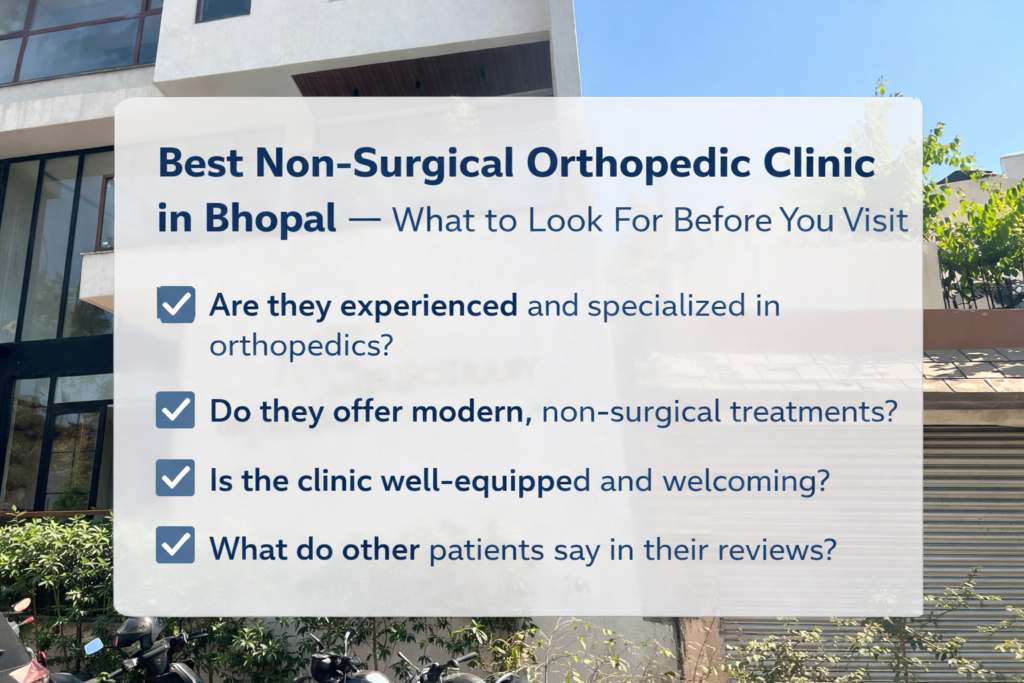
You Google “best orthopedic doctor in Bhopal.” You get a list. Everyone claims to be the best. Every clinic website says “world-class care” and “patient-first approach.” Helpful, right?
Not really.
Choosing an orthopedic clinic isn’t like choosing a restaurant. A wrong pick doesn’t just waste money — it wastes time, and sometimes makes the problem worse. Especially if you’re looking for non-surgical treatment, the clinic you choose matters more than you’d think. Not every orthopedic setup is equipped or even willing to explore options beyond surgery.
So before you book that appointment, here are 8 things worth checking. No fluff, no marketing talk — just the stuff that actually matters when you’re in pain and need the right doctor.
1. Does the Doctor Specialize in Non-Surgical Treatment — Or Is Surgery the Default?
This is the single biggest thing to ask. Most orthopedic surgeons are trained primarily as surgeons. Their expertise, their equipment, their revenue model — all built around operations. That doesn’t make them bad doctors. It just means non-surgical treatment might not be their first instinct.
If you’re specifically looking to avoid surgery (or at least explore all options before going there), you need a clinic where the doctor actively practices and believes in non-surgical orthopedics. Not one who offers physio as an afterthought before scheduling you for the OT.
What to check: Look at the clinic’s website and Google Business Profile. What services do they list first? Is it all about joint replacement and arthroscopy? Or do they prominently mention physiotherapy, PRP, rehabilitation, pain management? That tells you where their focus is.
At Medex Orthocare, for example, the entire practice is built around non-surgical treatment. Dr. Pragyesh Saxena’s approach starts with conservative management — surgery comes into the picture only when non-surgical options have been genuinely exhausted.
2. What’s the Doctor’s Qualification and Experience?
Sounds obvious, but you’d be surprised how many people book based on Google ratings alone without checking credentials.
For orthopedic care, you want a doctor with at minimum an MS (Orthopaedics) or DNB (Orthopaedics) degree. Fellowship training in a sub-specialty (sports medicine, spine, joint disorders) is a bonus because it means the doctor has spent extra years focused on a specific area.
What to check: The clinic’s website should clearly display the doctor’s degrees, training background, and years of experience. If it doesn’t, that itself is a red flag.
Experience with your specific problem also matters. A surgeon who does 200 knee replacements a year is great — if you need a knee replacement. But if you’re looking for non-surgical knee pain management, you want someone whose daily caseload involves exactly that.
3. Does the Clinic Have In-House Physiotherapy?
This one trips up a lot of patients. Many orthopedic clinics in Bhopal will diagnose you, prescribe a treatment plan, and then send you to a separate physiotherapy centre somewhere across town. You end up coordinating between two different places, two different schedules, and two professionals who may or may not communicate with each other.
A clinic with in-house physiotherapy means your orthopedic doctor and your physiotherapist are working in the same building, often consulting on the same patient in real time. Treatment adjustments happen faster. Progress tracking is tighter.
What to check: Ask directly — “Do you have physiotherapy at the same clinic, or will I need to go somewhere else?” If the physio setup is in-house and supervised by the orthopedic doctor, that’s a significant advantage.
4. What Treatment Options Are Actually Available?
“Non-surgical” isn’t one thing. It’s a range — from basic physiotherapy and medications to PRP therapy, hyaluronic acid injections, corticosteroid injections, customized rehab programs, bracing, and more. A good non-surgical orthopedic clinic should offer multiple options because different conditions respond to different treatments.
If a clinic’s non-surgical offering starts and ends with “rest karo, dawai lo, physiotherapy karo” — that’s a limited setup. You want access to a range of therapies so your doctor can combine and adjust based on how you respond.
What to check: Ask what specific non-surgical treatments the clinic provides. Can they do PRP? Do they offer viscosupplementation (hyaluronic acid injections)? Do they design customized exercise programs? The more tools the doctor has, the more flexibility you get in treatment.
5. Check Google Reviews — But Read Them Properly
Every clinic in Bhopal has Google reviews. The overall rating matters less than what people are actually saying. A clinic with 4.2 stars and detailed reviews about patient experience is often more trustworthy than one with 4.9 stars and 50 reviews that all say “Very nice doctor, good treatment.”
What to look for in reviews:
- Do patients mention specific conditions that were treated? (Knee pain, slip disc, sports injury)
- Do they talk about the treatment process, not just the result?
- Are there reviews from patients who did non-surgical treatment specifically?
- Do negative reviews mention being pushed toward surgery unnecessarily?
- Does the clinic respond to reviews — especially the critical ones?
What to check: Open the Google Maps listing. Sort by “Newest” instead of “Most Relevant.” Read at least 15–20 reviews. Look for patterns, not individual opinions.
Medex Orthocare’s Google listing has over 1,400 reviews with a 4.9 rating. More importantly, a large percentage of those reviews specifically mention non-surgical treatment, physiotherapy outcomes, and Dr. Pragyesh Saxena’s approach of explaining things clearly before suggesting a treatment path.
6. Does the Clinic Explain Things — Or Just Prescribe?
This is harder to check before your first visit, but you can get a sense from reviews and the clinic’s online content.
A good orthopedic doctor spends time explaining what’s wrong with your knee, back, or shoulder. They show you the X-ray and tell you what they see. They explain why they’re recommending a particular treatment and what the alternatives are. They tell you how long recovery will take and what role you need to play.
A not-so-good one glances at the X-ray, writes a prescription, and calls in the next patient.
What to check: Look at whether the clinic produces educational content — blog posts, social media videos explaining conditions, patient awareness material. Clinics that invest in patient education usually carry that same approach into their consultations.
Red flag: If a doctor recommends surgery in the first consultation without discussing non-surgical alternatives, get a second opinion. Unless you’re dealing with a fracture or an emergency, there should almost always be a conversation about conservative options first.
7. Location and Accessibility Actually Matter
You might think this is minor. It’s not — especially for orthopedic treatment, which often requires multiple visits over weeks or months. If your physio sessions are 3 times a week and the clinic is 45 minutes away in Bhopal traffic, you’ll start skipping sessions by week two. We’ve seen it happen over and over.
What to check: Is the clinic reasonably accessible from where you live or work? Is there parking or is it in a congested lane where getting in and out is a hassle? Is it easy to find, or will your auto driver circle the area twice?
Medex Orthocare is located in Arera Colony (E3/264, Near 10 No Stop, Behind Nalanda School) — one of the most centrally connected areas in Bhopal. This matters because patients coming for regular physiotherapy sessions need a clinic they can get to without the trip itself becoming a barrier.
8. Cost Transparency — Know Before You Go
Orthopedic treatment costs vary wildly in Bhopal. A consultation at a large hospital setup can be ₹700–1500, while a private clinic might charge ₹300–500. PRP sessions range from ₹3,000 to ₹8,000 per sitting depending on the clinic.
The number itself matters less than how upfront the clinic is about it. You shouldn’t find out the cost of your PRP session after the injection is done. You shouldn’t be surprised by “extra charges” for physiotherapy equipment or consumables.
What to check: Ask about consultation fees, treatment costs, and whether any packages exist for ongoing treatment (like physiotherapy cycles). A clinic that’s transparent about pricing before you commit is one that respects your decision-making.
Putting It All Together — A Quick Checklist
Before you finalize a clinic, run through these:
- Doctor has MS/DNB Ortho with relevant experience
- Clinic actively focuses on non-surgical treatment
- In-house physiotherapy available
- Multiple treatment options (PRP, injections, rehab, bracing)
- Google reviews mention real patient experiences (not generic praise)
- Doctor explains diagnosis and treatment clearly
- Location is accessible for repeat visits
- Costs are communicated upfront
If a clinic checks most of these boxes, you’re in good hands. If it fails on three or more, keep looking.
Why Patients in Bhopal Choose Medex Orthocare
We’ll keep this short because the rest of the article should have already given you the framework to evaluate any clinic, including ours.
Medex Orthocare in Arera Colony, Bhopal is a non-surgical orthopedic and spine care centre led by Dr. Pragyesh Saxena. The clinic treats knee pain, back pain, slip disc, cervical spondylosis, sports injuries, ligament problems, and joint disorders — with a conservative-first approach.
The clinic has in-house physiotherapy, offers PRP and injection therapies, and has treated thousands of patients from Bhopal and surrounding areas. The Google Business Profile carries over 1,400 reviews with a 4.9-star average, and most of those reviews describe the actual treatment experience in detail.
If you’re dealing with joint or spine pain and want to explore non-surgical treatment before committing to anything invasive — Medex is worth a visit.
Medex Orthocare — E3/264, Near 10 No Stop, Behind Nalanda School, Arera Colony, Bhopal